
Art and Politics Collide as Conflict Overshadows the Venice Biennale
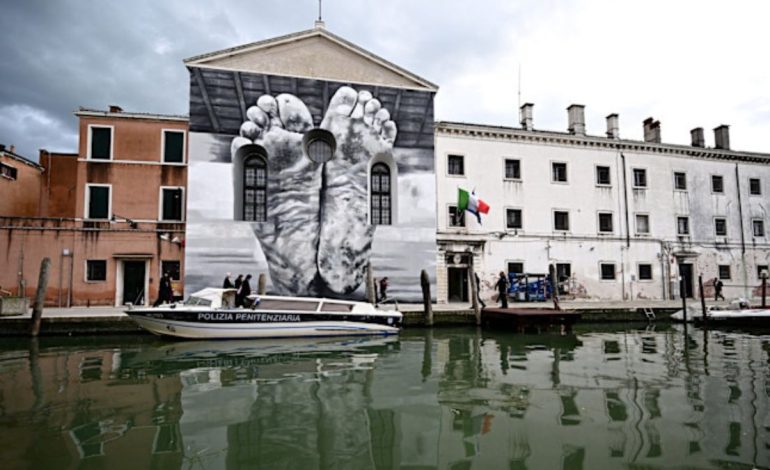

The 2024 Venice Biennale opens to the public this weekend facing an unusual challenge: how to remain a global gathering place for artistic expression when the world’s most acute conflicts have followed countries into its galleries.
Russia’s return to the Biennale for the first time since its 2022 invasion of Ukraine has sparked international outrage, while pavilions representing Israel, the United States, Ukraine, and a dedicated Palestinian exhibition mean that nations directly involved in active conflicts now stand yards apart in the gardens and exhibition spaces. The artistic celebration has become a stage for geopolitical division.
A Landscape Shaped by Conflict
The symbolic geography of the Biennale this year speaks volumes. The Russian pavilion sits just steps from a rescued deer sculpture brought from Ukrainian front lines. Israel has established a pavilion at the Arsenale, a former shipyard converted into additional exhibition space, positioned near Ukraine’s own presence. Police officers are stationed throughout these areas as a precaution against tensions.
The Palestinians, whose state remains unrecognized by Italy, do not have an official pavilion but are represented through “Gaza — No Words — See the Exhibit,” a dedicated exhibition at Palazzo Mora featuring approximately 100 pieces of hand-woven embroidery created by Palestinian women in refugee camps. The images, according to curator Faisal Saleh, founder of the Palestine Museum in Connecticut, convey the reality of Gaza more vividly than photographs alone could capture.
Protesting Art’s Political Moment
On Friday, roughly 2,000 pro-Palestinian demonstrators gathered in Venice to protest Israel’s participation, while earlier in the week members of Russian activist groups and the Ukrainian feminist collective Femen staged a joint protest at the Russian pavilion.
The controversy reflects a fundamental question about art’s role during times of global conflict: Should the Biennale remain a politically neutral space dedicated to aesthetic vision, or does the presence of nations at war inevitably transform it into a political arena?
The Artists’ Dilemma
The answer depends largely on perspective. Biennale President Pietrangelo Buttafuoco argued Wednesday that the Biennale’s historic purpose depends on its ability to remain apolitical: “If the Biennale were to start selecting not works but affiliations, not visions but passports, it would cease to be what it has always been: the place where the world comes together, and all the more so when the world is torn apart.”
Israeli artist Belu-Simion Fainaru expressed concern that the politicization threatened art itself. “The divisions at the Biennale are destroying the meaning of art to unite people. I don’t think we should reduce the art world to a political arena,” he told news agencies, speaking from the perspective of an artist whose installation, “The Rose of Nothingness,” features water fed through a drip irrigation system.
Italian Deputy Prime Minister Matteo Salvini echoed this position during a Friday visit, arguing that artists should not be treated as spokespeople for their nations’ policies: “I don’t think American, Chinese, Israeli or Russian artists are spokespeople for ongoing conflicts.”
Seeking Common Ground
In an attempt to address the tensions, organizers scheduled three evenings dedicated to reflection and “the theme of peace” during the pre-opening week, featuring contributions from Russian director Alexander Sokurov and Palestinian writer and architect Suad Amiry. These conversations represent efforts to reframe the Biennale around shared humanity rather than national divisions.
The curator of the Palestinian exhibition took a different stance, emphasizing that authentic representation requires acknowledgment of political reality. “There’s really no way to describe the horror that was inflicted upon the Palestinians in Gaza, and I don’t think we would want to be in the same place as the people who did that,” Saleh said, explaining why Palestinians chose separate representation rather than integration into the broader Biennale.
Art as Mirror and Message
The Venice Biennale’s current predicament reflects a broader tension in contemporary art: the impossibility of separating artistic expression from the political contexts in which artists create. The presence of embroidered testimonies from Palestinian refugee camps, a rescued Ukrainian sculpture, Russian pavilion installations, and Israeli installations means the Biennale has become less a celebration of aesthetic achievement and more a literal gathering of contested histories and ongoing trauma.
Whether that makes this year’s Biennale a failure or a profound expression of art’s true power remains deeply contested among those who have arrived in Venice.
Also Read:
Saudi Arabia Celebrates Strong Victory at Balkan Mathematical Olympiad