

Exploring Arab Artists on Display at the Diriyah Contemporary Art Biennale

RIYADH — The Diriyah Contemporary Art Biennale features a strong contingent of Arab artists whose works explore identity, displacement, language, and ancient storytelling. From abstract painting to sound installations and collage, the exhibition offers a diverse look at contemporary practice from the region.
Samia Halaby
The Jerusalem‑born artist, a leading figure in contemporary abstraction, has 11 works on display. Drawing inspiration from early Islamic architecture and the Soviet avant‑garde, Halaby translates movement and rhythm into vibrant compositions. One untitled piece from 1977 — part of her mid‑1970s experiments with optical effects — shows her use of limited colour palettes to create illusion. Halaby believes new painting approaches can transform not just aesthetics but teaching, technology, and society.
Hazem Harb
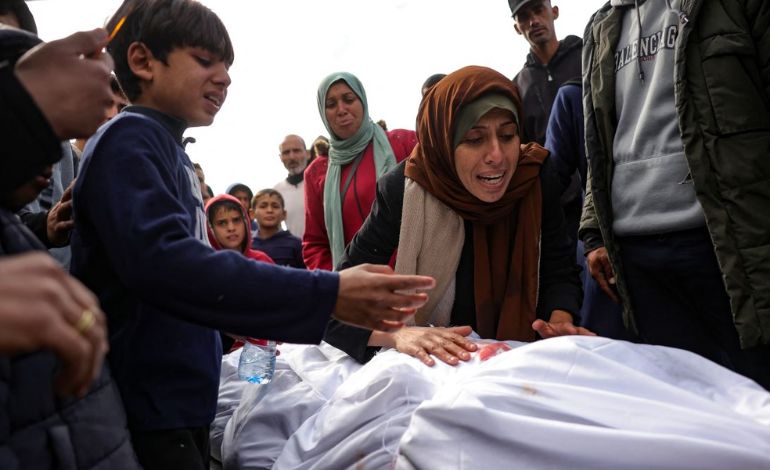
The Gaza‑born artist works with collage to examine exile and displacement. His “Gauze” series returns to a material made in Gaza for centuries. Arranging pieces of gauze on cardboard, he forms shapes resembling fallen human bodies. The gauze also evokes the kafan — the white burial cloth — referencing the many wrapped corpses in Gaza.
Nour Mobarak
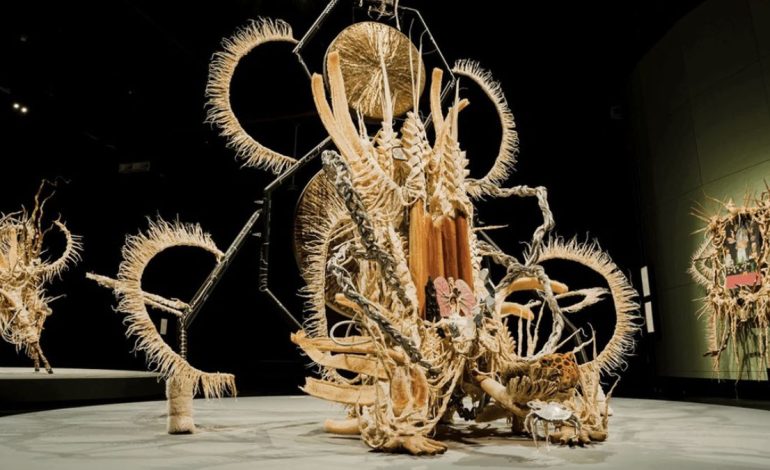
The Cairo‑born Lebanese artist reinterprets “La Dafne,” the world’s first known opera, in a large‑scale sound installation. The original score is lost, but the libretto survives. Mobarak translates it into rare and ancient languages, including the whistled Silbo Gomero and the click language !Xoon. Fifteen “singing” sculptures made of mycelium animate the piece, drawing parallels between fungal networks and linguistic systems — both repeat, decay, and regenerate.
Rand Abdul Jabbar
The UAE‑based Iraqi artist turns to the flood story from the “Epic of Gilgamesh” in a new commissioned installation. She focuses on enduring sites of collective life: the temple, date‑palm grove, clay pit, and city. Drawings stretched across wooden molds from Mexican brickmakers call forth the brickmaker as storyteller. Every fragment of earth, the work suggests, carries an imprint of the past into the present.
Yazan Khalil
The Palestinian artist’s video installation uses monitors of different sizes attached with objects, displaying videos, photographs, drawings, and texts. Khalil explores how language is mediated, negotiated, and reclaimed in daily life — not through AI systems but through sensory, affective experience. The concept of the glitch also features. Viewers must move around the installation to piece together its fragmented facets.
The biennale continues at Diriyah, offering a platform for these and other artists to engage with contemporary questions of memory, identity, and survival.
Also Read:
What the GCC Joint Statement Means for the Future of Tourism Growth
The Strong Warning by Makkah Grand Mosque Imam Against Online Misinformation