
How the Lebanon Conflict Raises Questions About War Violations
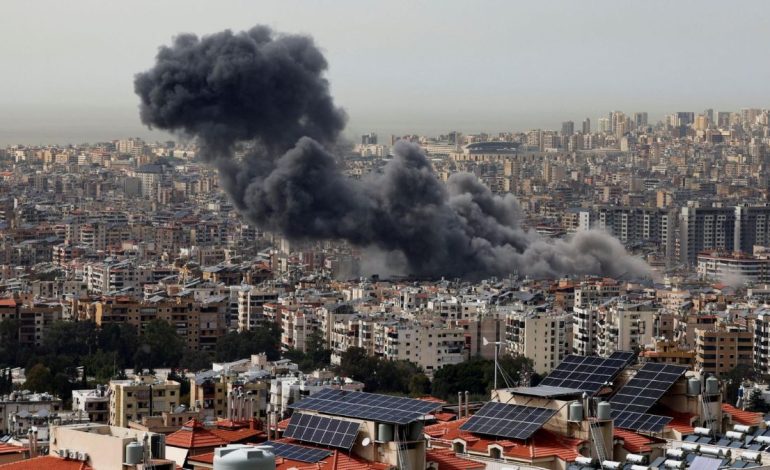

LONDON – As Israeli military operations against Hezbollah in southern Lebanon have killed over 1,000 people and displaced 1.2 million civilians in less than three weeks, growing concerns about potential violations of international humanitarian law underscore the challenges of enforcing rules of war in modern conflicts.
The scale of destruction and displacement has drawn comparisons to Gaza, where rights groups and UN officials have characterized Israel’s military campaign as potentially amounting to genocide. Israeli officials have explicitly referenced Gaza, with Finance Minister Bezalel Smotrich saying Beirut’s southern suburbs will “very soon look like Khan Younis,” a largely flattened Gaza city. Defense Minister Israel Katz warned that Lebanon “will look like Gaza” unless the country acts against Hezbollah.
The humanitarian toll reflects ongoing fighting despite a fragile ceasefire that took effect in November 2024. Since March 2, when Hezbollah launched its first major offensive action in 15 months, conditions have deteriorated rapidly. Schools converted into shelters barely accommodate ten percent of newly displaced persons. Overcrowding, insufficient food, and inadequate sanitation characterize emergency shelters holding 125,800 people.
International legal experts warn that Israeli strikes on densely populated urban centers raise serious questions about compliance with international humanitarian law. However, Hezbollah as a non-state armed group is equally bound by laws of war, including obligations to distinguish between civilians and combatants and adhere to proportionality principles.
The fundamental challenge lies not in the existence of legal frameworks but in their enforcement. International humanitarian law has no enforcement mechanism comparable to national police forces. Compliance depends on political will from all parties and surrounding states.
“When law enforcement relies on political will rather than institutional mechanisms, compliance becomes fragile,” said experts from the International Committee of the Red Cross. States often criticize adversaries while failing to hold allies to the same standards, undermining accountability.
The conflict exposes gaps in Lebanon’s capacity to manage escalation. The Lebanese government, pressured by Israel to act against Hezbollah, lacks the military capacity and political space to do so. An underfunded army and deep sectarian divisions make intervention impossible without risking internal fragmentation.
With neither side showing willingness to halt fighting, civilians continue bearing costs they did not create. The central question becomes not whether conflict continues, but how far destruction will extend and at what cost to civilian populations.
Also Read:
How Iranians Celebrate Eid During the Ongoing Middle East War