


Young Palestinian Boy Drowns as Flooding Hits Gaza Tent Camp, UN Reports

The image is one of profound, almost unbearable despair. Rescue workers, wading through muddy water choked with the wreckage of bombed buildings, pull at a small ankle protruding from the flood. The body of seven-year-old Ata Mai is finally lifted, wrapped in a sodden cloth, and carried away. He did not die from a missile or gunfire, but from drowning. His home was a tent. His killer was a rainstorm.
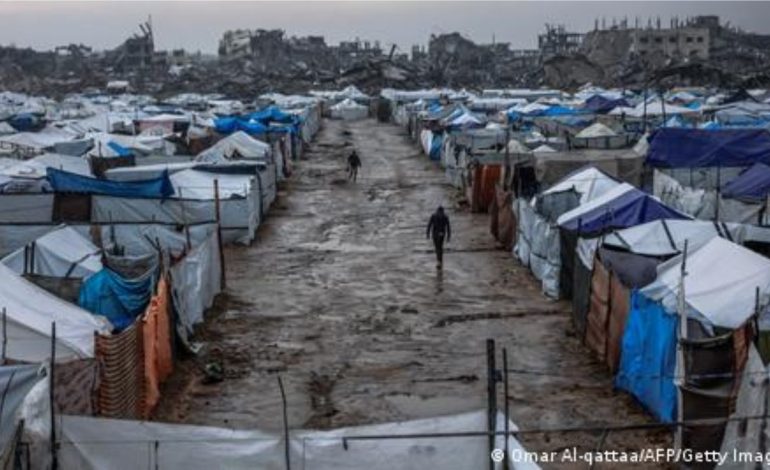
This week, UNICEF confirmed Ata’s death, a stark symbol of the new, grinding miseries winter is inflicting upon Gaza. Having survived two years of war, a child was lost to flooding that engulfed his family’s camp in Gaza City. He lived with his siblings and had already lost his mother to the conflict. Their world had shrunk to a cluster of around 40 tents, a fragile community repeatedly lashed by cold rains that turn roads to mud and collapse damaged buildings.
Ata is not an isolated tragedy. UNICEF reports he is at least the sixth child to die from weather-related causes in recent weeks. A four-year-old died in a building collapse. The Gaza Health Ministry speaks of children lost to hypothermia. “Appalling conditions that no child should endure,” describes Edouard Beigbeder of UNICEF, with tents blown away or collapsing entirely. For a population of over two million people, almost all displaced and living in squalid camps, the elements have become a lethal threat.
This unfolding humanitarian catastrophe exists within a tense and fragile calm. The large-scale bombardment has paused under a shaky 12-week ceasefire, but violence has not ceased. On the same day Ata’s death was reported, a nine-year-old boy, Youssef Shandaghi, died in Jabaliya in northern Gaza. The circumstances are contested—hospital officials cited Israeli gunfire from across the ceasefire “Yellow Line,” while a family member spoke of unexploded ordnance. The Israeli military stated it had no knowledge of the incident.
This ambiguity is itself a symptom of the daily reality. Medical personnel report that Israeli troops almost daily open fire on Palestinians near the demarcation line, often with deadly results. The military states it acts against threats, acknowledging some civilian casualties. Since the ceasefire began, the Gaza Health Ministry reports hundreds more Palestinians killed and wounded, adding to a staggering overall toll that exceeds 71,000 lives.
Meanwhile, in the occupied West Bank, a parallel strain of tension continues. Overnight raids by Israeli forces reportedly led to around 50 arrests, a practice that has surged since the war began. The Palestinian Prisoner’s Society alleges widespread abuse and vandalism during these operations, claims which could not be immediately verified. This cycle of arrest, raid, and confrontation fuels a separate, escalating crisis of violence in the territory.
The story of Ata Mai, however, cuts through the statistics and political complexities with brutal simplicity. It tells us that for the children of Gaza, survival now depends not just on escaping war, but on whether their tent can withstand the next storm. It tells us that the infrastructure of normal life—drainage, solid shelter, warm clothing—has been erased, leaving families exposed to the sky.
His death by drowning in a sea of mud is a metaphor for the entire crisis: a slow, suffocating struggle against forces that feel as vast and indifferent as nature itself. It is a piercing reminder that even when the guns fall relatively silent, the war continues its work, claiming the most vulnerable through hunger, disease, and now, the freezing rain.
As the world moves into a new year, the people of Gaza are fighting a battle against the cold, the floods, and a deep, grinding exhaustion. The international community watches as childhoods are literally washed away. The question hangs heavy in the air: how many more small ankles, how many more mud-stained shrouds, before this becomes untenable to the conscience of the world?
Also Read:
Gulf Nations Stand with Yemen to Improve Regional Security
Israel Army Kills Attacker After Car-Ramming Attempt in West Bank