
South Korea Urges Trump to Pursue Dialogue With North Korea

South Korean President Lee Jae Myung said Friday it’s clear President Donald Trump wants dialogue with North Korea, adding that he is personally urging Trump to pursue that engagement, while also confirming that Seoul will not send troops to intervene militarily in the war involving Iran.
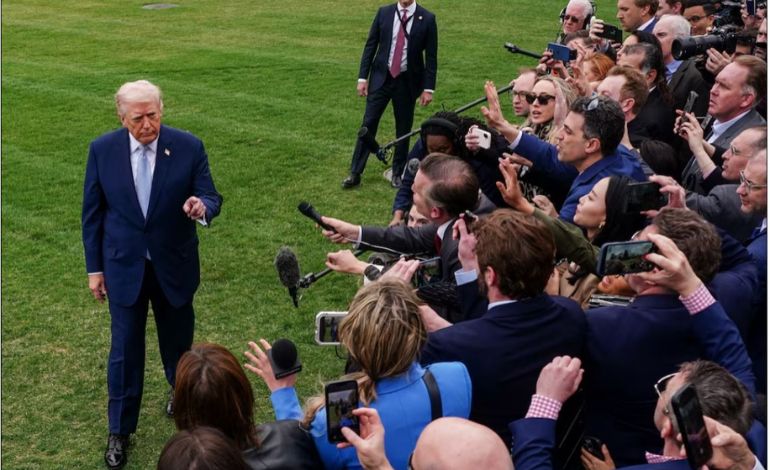
Trump, looking to revive the rapport he says he built with North Korean leader Kim Jong Un during his first term, said last month he plans to meet Kim later this year. Trump has also said it’s important to get along with Kim, noting that Pyongyang now possesses 57 nuclear weapons he described as very powerful, though Seoul estimates the North’s arsenal at somewhere between 80 and 120 weapons. North Korea, which has drawn increasingly close backing from Russia in recent years, has not offered a clear response to Trump’s overtures.
Speaking to reporters at the presidential Blue House, Lee said South Korea is continuing preliminary coordination efforts aimed at facilitating dialogue between Washington and Pyongyang, despite North Korea repeatedly labeling the South as an enemy. He acknowledged that arranging such a meeting remains difficult but not impossible, saying he can’t say for certain how likely it is, though it’s clear every possible effort must be made to turn that possibility into reality.
Lee’s comments came just hours after Kim Yo Jong, the powerful sister of North Korea’s leader, accused the United States of escalating regional tensions through frequent military drills and warned of a more aggressive response from Pyongyang going forward. A day earlier, she had dismissed any notion that North Korea would give up its nuclear weapons. South Korea and the US held a scaled-back version of their annual joint military exercises last month after Trump ordered them reduced.
On the Iran war, Lee was unambiguous that South Korea will stay out of any direct role, saying there will be no involvement or intervention in the war and that Seoul will not deploy troops or military assets in that capacity. His remarks follow reports that South Korea had been weighing a possible deployment near the Strait of Hormuz, a key flashpoint in the conflict between Israel, the US and Iran. Lee said South Korea will instead carry out only the minimum activities necessary to protect its own merchant ships and oil shipping routes, repeating that the country has upheld a principle of non-involvement throughout the conflict and intends to continue doing so.
Lee’s remarks come after Trump complained in a recent interview that Washington had received very little help from allied countries during the conflict, singling out South Korea, one of its key security partners in Asia. Trump said he hadn’t pushed hard when asking allies to participate, and that when he did, the response from South Korea and others was simply no thank you, a response he said he would remember. The US currently stations roughly 28,500 troops in South Korea, a legacy of the 1950-53 Korean War, which ended in an armistice rather than a formal peace treaty. Trump’s repeated criticism of longstanding alliances has nonetheless raised questions about the durability of US security commitments in East Asia.
Also Read:
Oil Market Under Pressure as Middle East Supply Concerns Recede
US Denies Palestinian Leader Mahmoud Abbas Visa for UN General Assembly