



Israel Imposes New Movement Restrictions on Three Christian Towns in Southern Lebanon
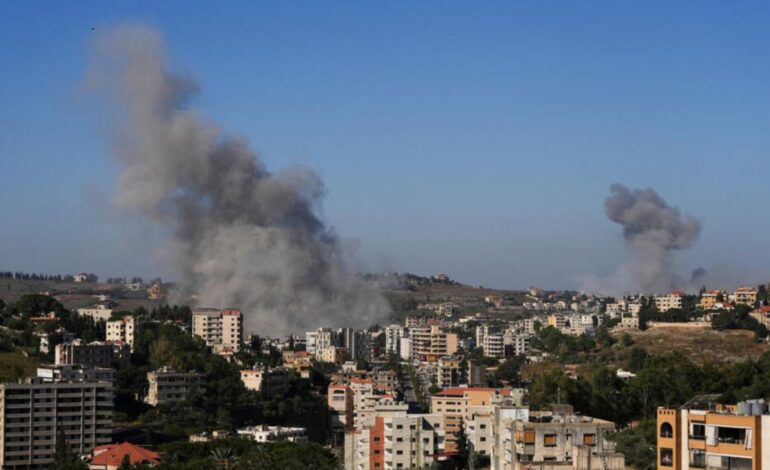

The Israeli military has imposed new movement restrictions on three besieged Christian towns in southern Lebanon, requiring residents to travel in prearranged convoys along a single designated route through Naqoura.
Residents of Rmeish, Debel, and Ain Ebel in the Bint Jbeil district must now register their vehicles and submit travelers’ details before entering or leaving the towns. All three remain encircled by Israeli forces occupying every neighboring community, with relief and medical supplies reaching residents only through convoys escorted by the United Nations Interim Force in Lebanon.
Local sources in Rmeish told Asharq Al-Awsat that no vehicle is permitted to travel alone, with at least one convoy of several cars or buses departing one of the three towns each day. The Lebanese army and UNIFIL organize these convoys, which follow the coastal road south of Tyre to Naqoura before continuing to the Christian towns. The army escorts vehicles as far as Qlayleh, roughly 15 kilometers from the Israeli border, after which UNIFIL vehicles take over for the remainder of the journey. Travelers must register in advance, and their identities and vehicles are checked as part of coordination with Israeli forces to allow passage.
The restrictions have prompted the Vatican, through its ambassador to Lebanon, to appeal to the United States to intervene and prevent further limits on movement for residents of the Christian villages, according to sources who spoke to Asharq Al-Awsat.
Notably, the measures apply only to Christian villages in the Bint Jbeil district and do not extend to those in the neighboring Marjayoun district. Residents and visitors can move freely between Qlayaa, Jdeidet Marjayoun, Burj al-Mulouk, and Deir Mimas, using a route through Lebanon’s Western Bekaa toward Hasbaya. However, these communities remain barred from hosting people displaced from nearby areas, and journalists visiting the region are prohibited from photographing the nearby town of Khiam. Israeli forces stationed in Kfar Kila and Tall al-Nahhas also erected earth mounds this week near key junctions close to inhabited homes in Burj al-Mulouk.
Meanwhile, the Israeli military has continued demolishing towns inside the so-called “yellow line,” systematically destroying remaining homes. A senior security source told Asharq Al-Awsat that trucks carrying explosives have been accompanying Israeli patrols, with explosives placed around homes after they are looted and before demolition. This method has been used extensively in Mais al-Jabal, the largest town in Marjayoun district, where only dozens of housing units remain standing after more than 5,000 homes and commercial properties were destroyed. The latest demolition targeted a school complex built with support from the Iraqi government, along with nearby homes. Specialized equipment has also been used to pulverize concrete, making it easier to extract reinforcing steel from destroyed buildings for transport into Israel, the source said.
Additional incidents were reported across the region. An Israeli force advanced into Tallat al-Sawwan in Mayfadoun before dawn Tuesday, taking up positions inside a house, while military vehicles moved from Hadatha into Haris and fired machine guns toward the town’s outskirts. Lebanon’s National News Agency reported intensified attacks on villages in western Tyre district, including airstrikes on Mansouri and Wadi Hassan in Tayr Harfa, alongside large-scale demolitions in Mansouri and Majdal Zoun. Israeli artillery also shelled Ainata and Beit Lif in Bint Jbeil district.
Also Read:
Strait of Hormuz Traffic Drops Sharply Amid Prolonged Iran War