



Syria Dismisses Seismic Activity as Cause of Mysterious Mount Kawkab Vapors
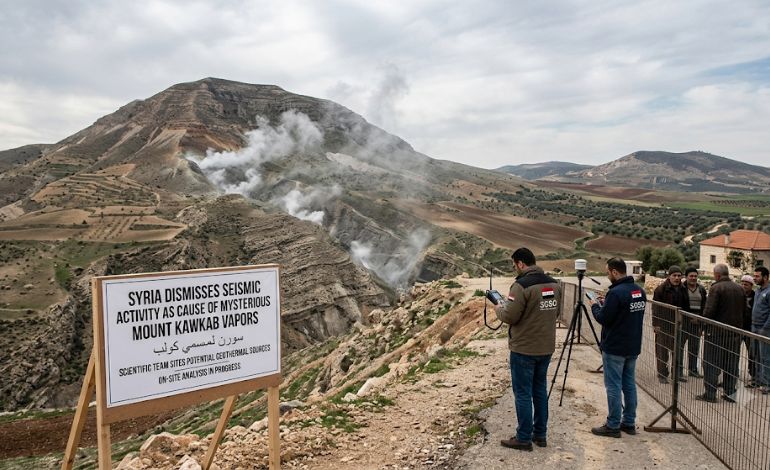

Unusual vapors were seen rising from Mount Kawkab in northeastern Syria. A joint Syrian technical committee inspection said it is most likely caused by human activity rather than seismic or tectonic activity.
The committee, which included experts from the General Establishment of Geology and Mineral Resources at the Ministry of Energy, the National Earthquake Center and the Hazardous Materials Response Department at the Ministry of Emergency and Disaster Management, conducted geological, structural, tectonic and seismic assessments of the area.
The findings were reported Wednesday by Syria’s state news agency SANA.
Technical Team Find Signs Of Human Activity
The committee said its assessment found an old waste dump between two volcanic flows, with some of the material buried under loose and uneven soil. Investigators also found signs that plastic materials and rubber tyres had recently been burned in the area.
The team examined several possible explanations for the vapours, including gases escaping through underground faults following seismic activity, groundwater-related emissions, hydrocarbon gases and human activity.
After geological, structural, tectonic and seismic assessments, the committee ruled out an earthquake or tectonic activity as the cause.
It said there had been no major earthquakes near Mount Kawkab capable of changing underground stress conditions or creating fractures that could allow deep gases to reach the surface.
Recent earthquakes not linked to vapors.
The committee also examined whether an earthquake that struck southern Turkiye on Sept.24 could have been responsible.
The 5.3-magnitude earthquake near Şanlıurfa occurred about 203 kilometres from Mount Kawkab. Investigators concluded that it was neither strong nor close enough to have caused the vapors.
The investigations began in late September after vapors, ground subsidence and cracks were reported around Mount Kawkab. Authorities warned residents and journalists to stay away while teams checked the area for possible mines, war remnants and hazardous gases.
Further geological and technical assessments later pointed to human activity as the most likely cause, with investigators finding buried waste, unevenly buried material and signs of recent burning.
Mount Kawkab is a significant geological formation located about 15 kilometres east of Hasakah city. It stands around 516 metres high and has a diameter of approximately one kilometre.
The mountain was formed through volcanic activity, which explains why much of it is covered with basaltic rock. It is currently considered a dormant volcanic formation and has long been a special place for the residents of Hasaka.
Also Read:
Trump to give Putin briefing on death of plague lab worker in Russia
Europe is Spending Hundreds of Billions on Space. Can Glasgow’s Satellite Sector Keep Pace