


War Drives Iran’s Currency to a New Record Low Amid Economic Turmoil
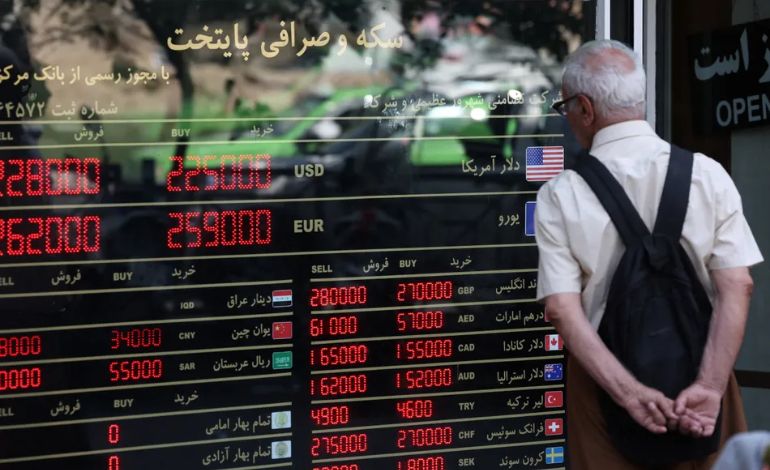

Iran’s currency fell to a fresh record low on Tuesday, with traders in Tehran exchanging more than 2.5 million rials to the US dollar, underscoring how steadily the war in the Middle East has eroded the country’s economy.
The latest drop came just 27 days after the rial hit its previous low of 2.2 million to the dollar on September 2, part of a pattern of repeated record lows since the war began in February. Iran’s economy has struggled under international sanctions for years, but a US naval blockade on Iranian oil and fresh sanctions imposed since the war started have pushed it into a steeper decline.
Amid the economic pressure, Iran’s Foreign Minister Abbas Araghchi said indirect negotiations with the United States over reopening the Strait of Hormuz, the war’s central chokepoint, have grown more serious. Speaking to Iranian media Monday night shortly before leaving New York, where he had attended the UN General Assembly and met with Pakistani and Qatari mediators, Araghchi said the current focus is solely on the strait. He said Qatari intermediaries are expected to raise the matter again with the American side, after which Washington’s final response would be passed back to Tehran for a decision. Officials, including from the US, have confirmed to the Associated Press that mediators are actively working with both sides on a possible deal to end the fighting and reopen the strait, even after President Trump rejected an earlier Iranian proposal this week to reopen it within seven days in exchange for lifting the port blockade, releasing frozen assets and waiving oil sanctions.
Tensions in the strait were underscored Tuesday by a report that a cargo vessel was struck by an unknown projectile while transiting the waterway Monday. The UK Maritime Trade Operations agency said it received a delayed report of the incident, noting the strike caused a fire that was extinguished, with all crew members reported safe and the unidentified vessel continuing on its route. No one has claimed responsibility for the attack.
Separately, the Trump administration announced new sanctions Tuesday against 10 individuals and entities based in Iran, Hong Kong and Pakistan, accused of procuring weapons and components for Iran’s defense ministry. The action is part of the administration’s Operation Economic Outcast campaign, aimed at cutting off financial support to Tehran. Treasury Secretary Scott Bessent said in a statement that Treasury will not tolerate any support to the regime and will keep working to identify and isolate Iran’s enablers.
Iran, for its part, delivered a pointed message aimed at the American public. Revolutionary Guard Corps spokesman Gen. Hossein Mohebbi read a letter at a news conference in Tehran urging ordinary Americans to pressure their government to end the war, arguing that the conflict will only end once Washington acknowledges defeat and withdraws from the Middle East. He accused the US of using Iran’s nuclear program as a pretext to seize the country’s wealth and turn it back into what he described as a colony, and said this is how the war will end. The remarks came weeks ahead of the US midterm elections, with polling suggesting the war, and the higher gasoline prices tied to it, have weighed on the American public’s mood heading into the vote.
Trump and senior officials continue to express confidence that Iran’s economy cannot sustain the conflict much longer and that Tehran will eventually be forced to give ground. Trump initially predicted the war would last only weeks, and has more recently suggested it will likely end after the November US elections. Secretary of State Marco Rubio said on Fox News Monday that Iran is heading toward economic collapse, arguing that cutting off oil revenue and imposing sanctions is preventing Iran from getting access to money that it would use to fund weapons and threaten others, calling it a necessary step to curb Tehran’s ambitions, including toward a nuclear weapons program.
In a separate development, a Saudi government official said a major pipeline in the kingdom that had been shut down earlier this month after an attack is now operating again, with output near pre-attack levels and full capacity expected within a few weeks. Saudi Arabia relies on the 1,200-kilometer East-West Pipeline to move crude from Gulf processing facilities to Red Sea export terminals, and blamed an Iran-backed militia in Iraq for the drone strike that forced its temporary closure. Satellite data from analytics firm Kpler showed tankers loading roughly 12.5 million barrels of oil at the pipeline-fed Yanbu export terminal and the nearby Al Muajjiz terminal on Sunday.
Also Read:
AlUla Celebrated With Gold Award for Responsible Tourism in 2026
Muslim World League Renews Call for Palestinian State Amid Gaza Crisis