
Trump to Reveal Gaza Funding Strategy at First Board of Peace Meeting

President Donald Trump will take the next significant step in his ambitious Gaza reconstruction initiative next week, announcing a multi-billion dollar funding strategy and detailing plans for a United Nations-authorized stabilization force at the first formal meeting of his newly created Board of Peace.
The February 19 gathering in Washington, chaired by Trump himself, is expected to draw delegations from at least 20 countries, including numerous heads of state, according to two senior US officials who spoke on condition of anonymity.
From Davos to Washington
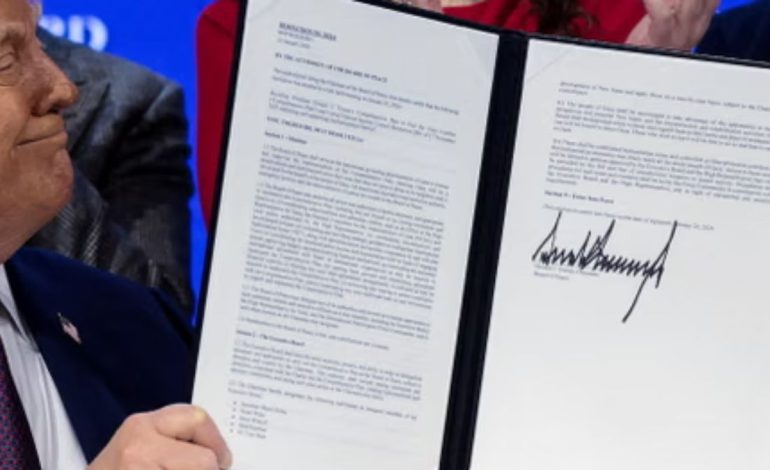
The Board of Peace was formally established on January 23, when Trump signed founding documents in Davos, Switzerland. Its creation received the endorsement of a UN Security Council resolution, anchoring the initiative within international legal frameworks—a deliberate effort to address concerns about unilateralism.
While regional powers including Turkiye, Egypt, Saudi Arabia, Qatar, and Indonesia have joined the board, traditional Western allies have adopted a more cautious posture. Israeli Prime Minister Benjamin Netanyahu confirmed during his Washington visit this week that Israel has also joined.
The Funding Framework
Central to next week’s meeting will be Trump’s announcement of a multi-billion dollar reconstruction fund for Gaza. One US official characterized member contributions as “generous,” emphasizing that the United States had made no explicit fundraising requests. “People have come to us offering,” the official said.
The president will detail precisely how much has been raised and from which sources—information that has been closely guarded until now.
A Stabilization Force Takes Shape
Deployment of an International Stabilization Force represents the next phase of Trump’s Gaza plan, first outlined in September. The current ceasefire, which began October 10, has seen hostage releases by Hamas and Israel’s reciprocal freeing of Palestinian detainees. Now, attention shifts to the day after.
Several countries have indicated they will contribute thousands of troops to the stabilization force, which is expected to deploy in Gaza in the coming months. Their mandate will include supporting the newly established National Committee for the Administration of Gaza, which assumed responsibility for civilian governance from Hamas in January.
The Disarmament Question
A primary challenge remains the disposition of Hamas fighters. Under Trump’s plan, members who commit to peaceful coexistence and voluntarily decommission their weapons will receive amnesty. Those wishing to depart Gaza entirely will be provided safe passage to receiving countries.
The success of this approach hinges on persuading armed factions to surrender weapons voluntarily—a proposition of uncertain outcome.
Beyond Gaza
Some observers have expressed concern that the Board of Peace might expand its mandate beyond Gaza, potentially competing with UN mechanisms. US officials sought to allay such fears, emphasizing that next week’s meeting will focus exclusively on the Palestinian enclave.
Still, the creation of a parallel diplomatic structure—endorsed by the Security Council but operating under Trump’s chairmanship—represents an unconventional approach to conflict resolution. Whether it remains confined to Gaza or evolves into a broader instrument of American-led peacemaking will be closely watched.
What Comes Next
The February 19 meeting will produce concrete announcements: funding totals, troop commitments, and governance updates. But deeper questions will linger. Can a force assembled under American auspices secure lasting stability? Will Hamas members accept amnesty and disarmament? Can Gaza be rebuilt while its political future remains unresolved?
Trump’s Board of Peace now moves from concept to operation. The world will be watching to see whether this ambitious experiment in conflict resolution can deliver what years of traditional diplomacy have not.
Also Read:
Key Highlights from the German Parliament Speaker’s Visit to Gaza
Colors of the Desert: Sahara Cultures Take Center Stage in Chad