Saudi–Pakistan Military Talks Focus on Preventing Iranian Attacks on the Kingdom
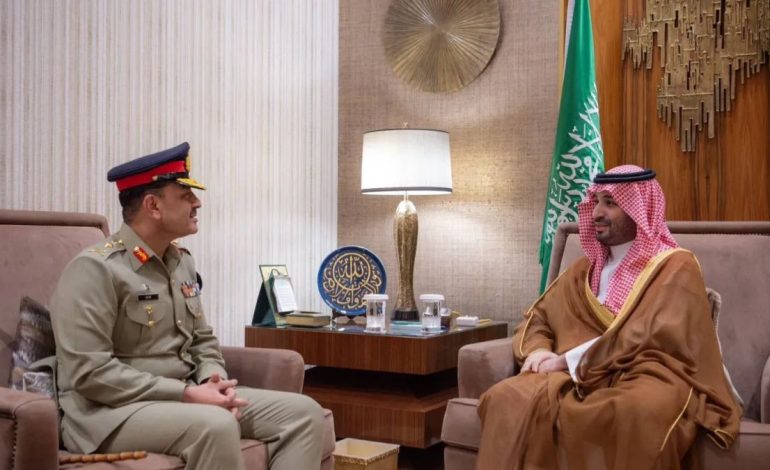

In the tense corridors of power in Riyadh, a message was being sent not just within the Kingdom’s borders but across the entire Middle East. Saudi Arabia’s Defense Minister Prince Khalid bin Salman sat down with Pakistan’s Chief of Defense Forces Asim Munir to discuss a shared threat: Iran’s military aggression against the Kingdom. The conversation, simple on its surface, carries profound implications for regional security and the growing weight of an alliance forged just months earlier.
“We discussed Iranian attacks on the Kingdom and the measures needed to halt them,” Prince Khalid announced, his words carefully chosen but unmistakably firm.
A Crisis That Extends Beyond Borders
The backdrop to these talks is one of escalating military tension that has transformed the normally stable Arabian Gulf into a zone of active conflict. Since February 28, when the United States and Israel launched a large-scale military campaign against Iran, the region has descended into a dangerous spiral of attack and counterattack.
Iran has not remained passive. Drones have streaked across the skies. Missiles have been launched at multiple sites throughout the Gulf. Military assets belonging to the United States and Israel have been struck. But the damage extends beyond military installations. The attacks have rattled the global economy by threatening the free passage of energy shipments through the Strait of Hormuz—one of the world’s most critical chokepoints for oil and gas.
On Saturday alone, Saudi Arabia reported shooting down a number of drones targeting the Shayba oil field in the Empty Quarter, one of the Kingdom’s most critical energy installations. Days earlier, a drone had struck the US embassy in Riyadh, causing a fire and sending an unmistakable message that no target—not even diplomatic facilities—was beyond reach.
The threat is real. The consequences are immediate. And Saudi Arabia cannot face this challenge alone.
An Alliance Born of Necessity
Six months earlier, in September, Saudi Arabia and Pakistan had signed what they called a “Strategic Mutual Defense Agreement”—a document with teeth. The agreement was not ceremonial. It carried explicit language: aggression against one country would be treated as an attack on both. It was a binding commitment, a public declaration that the two nations would stand as one.
At the time, the agreement seemed forward-thinking but perhaps not urgently necessary. Now, with drones falling from the sky and oil fields under siege, that agreement has moved from the realm of strategy into the realm of survival.
Prince Khalid’s statement made this explicit: “We discussed Iranian attacks on the Kingdom and the measures needed to halt them within the framework of our Joint Strategic Defense Agreement.” The framework mattered. The agreement mattered. Pakistan’s commitment mattered.
The Weight of Solidarity
The significance of Pakistan’s involvement cannot be understated. Pakistan is not a wealthy Gulf state with abundant resources to spare. It is a nation managing its own complex security challenges, its own economic difficulties, its own internal pressures. Yet when Saudi Arabia called, Pakistan answered. When the Kingdom faced threats, Pakistan’s interior minister reached out to affirm solidarity.
Interior Minister Raza Naqvi called his Saudi counterpart, Prince Abdulaziz bin Saud bin Naif, to condemn the attacks and affirm his country’s commitment to confronting any threats to Saudi Arabia’s security and stability. It was not mere lip service. It was formal acknowledgment through official channels that Pakistan stood with the Kingdom.
This matters because alliances in the Middle East are often transactional and fragile. They shift with the winds of politics and circumstance. But a commitment made in September, honored in March, carries weight. It suggests something more durable.
A Message About Regional Balance
The talks between the two defense chiefs carried another message as well: careful, measured, but unmistakable. “We stressed that such actions undermine regional security and stability and expressed hope that the Iranian side will exercise wisdom and avoid miscalculation,” Prince Khalid said.
These are diplomatic words, yes, but they contain a warning. The phrase “avoid miscalculation” is particularly telling. It suggests that Iran may be overestimating its position or the depth of regional support for its actions. It implies that further escalation could trigger consequences beyond what Iran anticipates.
The message, in other words, is that Saudi Arabia is not isolated. It has backing. It has partners willing to stand beside it. That changes calculations—not just for Iran, but for every actor in the region watching this play out.
The Stakes for Global Stability
While Saudi and Pakistan focused on bilateral security, their conversation has implications that extend far beyond their borders. The Strait of Hormuz—through which roughly one-third of the world’s seaborne oil passes—remains under threat from Iranian military action. Energy prices remain volatile. Shipping insurance costs have spiked. Global markets watch the Gulf with growing anxiety.
An escalation that destabilizes Saudi Arabia destabilizes the world economy. An attack on major oil installations could send shockwaves through markets already fragile from competing crises. The Kingdom is not just defending itself; it is effectively defending the economic interests of dozens of countries dependent on stable energy supplies from the region.
Pakistan’s willingness to align itself publicly with Saudi Arabia on this issue signals to the world that the threat is serious enough to warrant international attention and partnership.
What Comes Next
The immediate question is whether these military talks will translate into concrete action. Will Pakistan provide military support? Intelligence sharing? Naval coordination in the Strait of Hormuz? The defense agreement framework allows for these measures, but the specific implementation remains to be determined.
The longer-term question is whether this alliance can serve as a deterrent—whether Iran will exercise the “wisdom” and restraint that Prince Khalid called for, or whether it will see Pakistani involvement as merely another obstacle to overcome in its confrontation with Saudi Arabia and Western powers.
Standing United in Uncertain Times
What is clear is that Saudi Arabia and Pakistan have moved from partnership on paper to partnership in practice. When threats become real, rhetoric becomes action, and alliances are tested. This week’s talks represent a moment when two nations—one wealthy and strategically vital, one militarily experienced and regionally influential—decided that their futures were linked enough to stand together.
In a region where suspicion often outweighs trust and interests frequently diverge, that decision carries significance. It suggests that when the stakes rise high enough, when the threats become visible enough, nations find ways to cooperate.
Whether that cooperation can prevent the very escalation both countries fear remains to be seen. But for now, the message is clear: Saudi Arabia faces its challenges no longer alone, and Iran must recalibrate its understanding of regional alignments and the price of further miscalculation.
Also Read:
Iranian Envoy Denies Tehran Ordered Attack on US Embassy in Riyadh
Saudi Arabia Intercepts 3 Ballistic Missiles Aimed at Prince Sultan Air Base