



How a Recreated Bronze Age Boat Transformed Knowledge of the Gulf’s Maritime History
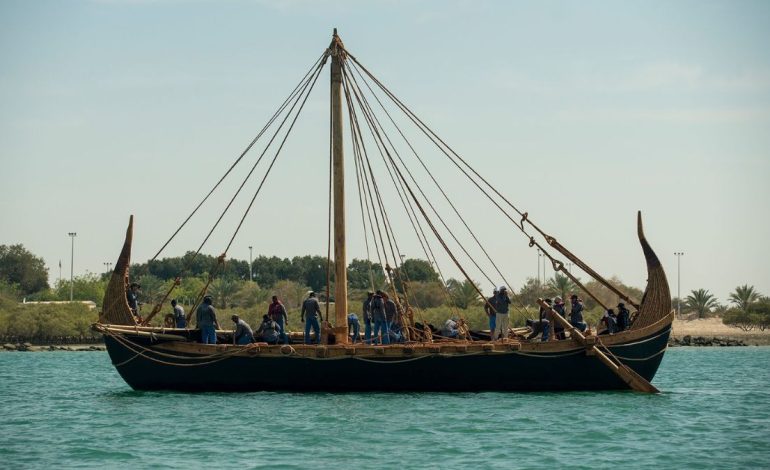

LONDON — When the Zayed National Museum opens in Abu Dhabi this December, visitors will be greeted by a striking sight: a full-scale recreation of a Bronze Age merchant vessel, painstakingly rebuilt to reveal how ancient mariners once connected civilizations across the Arabian Gulf.
This remarkable boat—dubbed the Magan Boat—represents the culmination of a groundbreaking experimental archaeology project that has reshaped our understanding of the region’s maritime heritage. For three years, historians, archaeologists, and traditional boatbuilders collaborated to reconstruct a vessel that would have sailed 4,000 years ago, carrying copper, pottery, and other goods between ancient Mesopotamia and the Indus Valley.
Uncovering a Lost Maritime Legacy
The inspiration for the project emerged from ancient cuneiform tablets discovered in the late 19th century at the Sumerian city of Nippur. One tablet recorded that King Sargon the Great “moored the ships of Meluhha, Magan and Tilmun at the quay of Agade.” These lands are now understood to span modern-day India and Pakistan (Meluhha), Oman and the UAE (Magan), and Bahrain, Qatar, and eastern Saudi Arabia (Tilmun).
Further evidence came from bitumen fragments discovered at coastal archaeological sites from Kuwait to Oman. These tar-like pieces, used to waterproof hulls, bore clear impressions of reed bundles and rope—revealing the construction methods of ancient Gulf vessels. Some fragments even retained ancient barnacles, confirming their long-ago immersion in seawater.
Building the Magan Boat
Led by maritime historian Eric Staples and crafted by skilled boatbuilders from Kerala, India, the reconstruction began with over a year of intensive research. The team relied on clues from multiple sources:
- A 4,000-year-old “parts list” tablet from Girsu detailing materials for “Magan boats”
- Model boats and engraved seals depicting Bronze Age vessels
- Physical bitumen samples with reed and rope impressions
The final vessel measures approximately 12 meters and is constructed from reed bundles, wooden frames, and palm-fiber ropes, sealed with natural bitumen. Its distinctive curved “horns” at bow and stern echo artistic representations from antiquity.
Sailing into New Understanding
In February 2024, the Magan Boat underwent successful sea trials in Abu Dhabi’s coastal waters—demonstrating the seaworthiness of ancient designs and confirming that such vessels could have undertaken long-distance trade across the Arabian Gulf.
Peter Magee, director of Zayed National Museum, emphasized the project’s significance: “This speaks to the fact that there is a very long history of maritime engagement in this country, stretching back to the Neolithic period and certainly to the Bronze Age.”
The Magan Boat now stands as the centerpiece of the museum’s opening exhibition—not just as a static display, but as living proof of the sophisticated trade networks that once linked the great civilizations of the ancient world, and as testament to the enduring maritime spirit of the Gulf.
Also Read:
May Saw a Two-Year High for Saudi Arabia’s Non-Oil Exports of $7.70 Billion, According to GASTAT.